With Grow, your site can have a blog: posts you write yourself — tips, news, answers to what people ask you — that Google reads. You write them in the dashboard, in Content › Blog (the “Content” square at the top right), and they appear on your site's Blog page, at yourbusiness.wiweb.me/blog.
Adding the Blog page to your site#
- In My Web, open the “My pages” menu. The pages you don't have yet appear below yours, with a “+” in front and “Add” on the right. Press “Blog”.
- From then on, Blog appears in the Content menu. Without the page it doesn't: the blog is only in Content if your site has it.
- At the top of Content › Blog you change the “Page title” and its “Subtitle”; they save by themselves.
- Publish your site so the page reaches it.
The Blog page doesn't appear on your site until you publish the first post. An empty page isn't served, just like a gallery with no photos.
Writing a post#
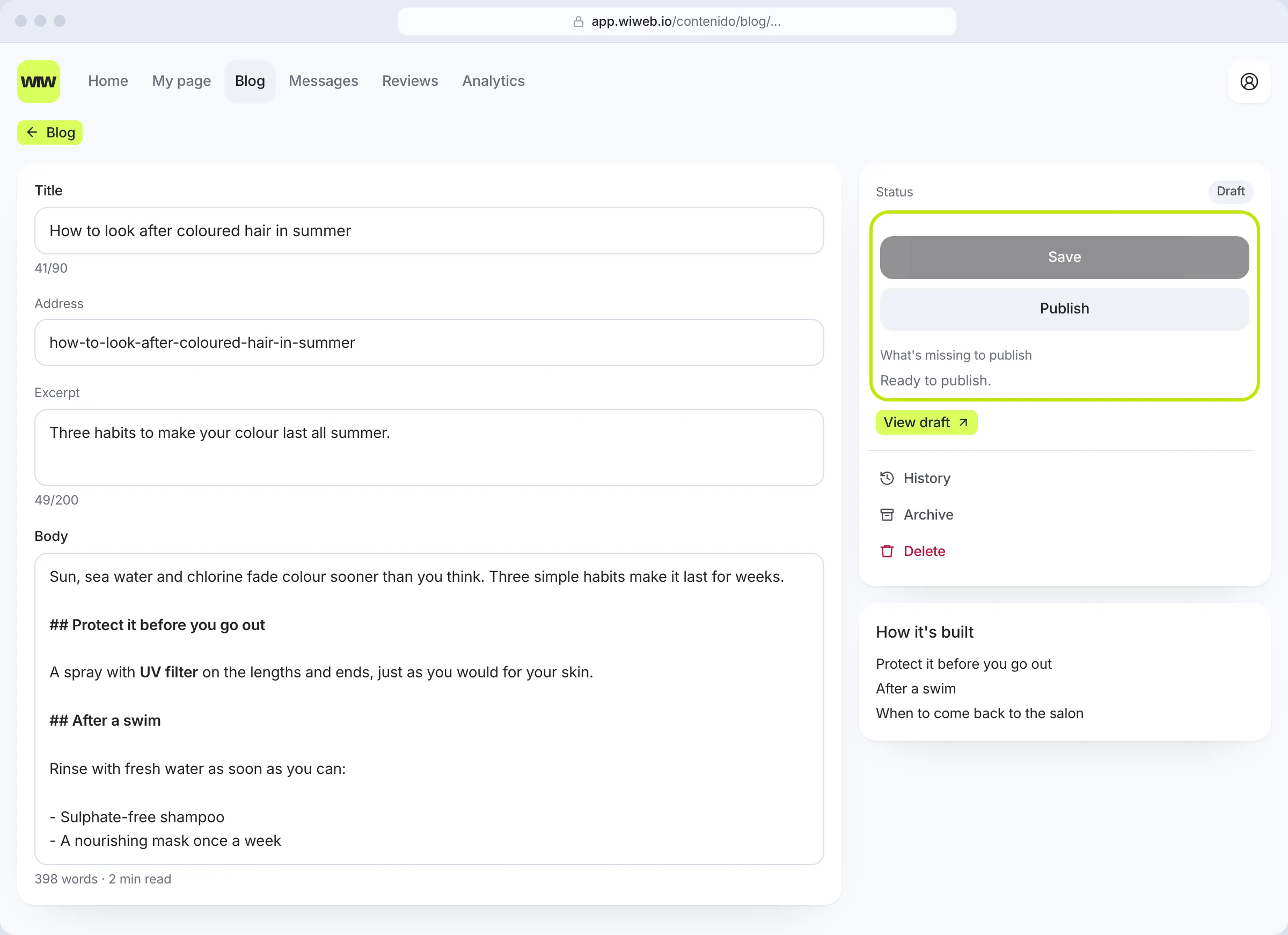
- In Content › Blog, under “Posts”, press “New post”. A draft is created and you go into it.
- Write the “Title”. While the post is a draft, its “Address” writes itself from the title; you can change it.
- Write the “Body” in Markdown:
## A heading,**bold**,- a list,[a link](https://…). Below it you see how many words it has and how long it takes to read; on the right, “How it's built”, the post's headings. - Add the “Cover photo”, what it shows, the “Tags” and the “Byline” (left empty, it's signed with your business name).
- Under “On Google”: the title and description shown on Google and the keyword you'd like people to find it by. The counters turn red when you go over.
- Press “Save”. Unlike the rest of the dashboard, the post editor doesn't save by itself: if you leave with unsaved changes, we ask “Leave without saving?”.
Photos inside the text have to be uploaded to wiweb; photos from other websites aren't published.
Viewing the draft and publishing#
“View draft” opens the post in another tab exactly as it will appear on your site, with your style. Only you can see it.
In the panel on the right, “What's missing to publish” tells you the first thing to fix: the title, a proper address, at least 200 characters of body text. When it says “Ready to publish.”, press “Publish”: the post is on your site at that moment, without publishing the site again. Once published, “View on your site” opens it.
Once published, the address no longer changes: it's the one Google has and the one in any links you've shared. You can still change the title.
Asking wi for a draft#
In the blog list, “Ask wi for a draft” asks you for the topic (“How to look after coloured hair in summer”). In a few minutes wi leaves a draft here, written with what it knows about your business, without making up facts or prices. It's never published by itself: you read it, change whatever you like and publish it yourself. wi writes one at a time.
wi's plan: ideas to write about#
In Content › Blog › “Plan” (at the top right of the blog card, next to “Posts”), wi suggests five topics every Monday. They come from what people really search for:
- “Asked to AI”: questions people ask AI assistants where your business doesn't come up, from the monthly analysis.
- “Searched on Google”: the searches people found you with, if your Google Business Profile is connected.
- “People ask you”: the questions on your FAQ page you haven't answered yet.
- “From your business”: your services, when the rest isn't enough for five.
Each idea says why it's worth writing and “How I'd build it”, section by section. Press “Use this idea” and wi leaves you a draft with the title, each section's heading in the body and, on the right of the editor, “wi's outline”: what to cover in each part, for inspiration. The outline doesn't appear on your site; remove it with “Remove the outline” when you no longer need it. You write the post yourself: until the body has real text, “What's missing to publish” won't let you publish it.
“Dismiss” removes an idea and wi won't suggest it again. “Ask for other ideas” prepares five new ones on the spot, up to three times a day; Monday's ideas replace the ones you haven't used.
In several languages#
If your site has more than one language, each post has one version per language, with its own title and its own address. You switch versions at the top of the editor; a missing one is requested with “Translate into Catalan” (or whichever language): wi adapts it and leaves it as a draft. In the list, a filter at the top shows the posts in one language.
If you change the original afterwards, the translation is marked “Out of date”. Review it and press “Mark as up to date” when it's current.
Unpublishing, archiving, deleting and history#
- “Unpublish”: the post leaves your site and becomes a draft again.
- “Archive”: it leaves your site and the blog list, but stays saved.
- “Delete”: deletes it along with its history, after asking you. Versions in other languages stay.
- “History”: every time you save, publish or unpublish, a version is kept. “Restore” saves that one as the current version.
Where else your blog appears#
- On your home page, with the “Latest posts” widget: the three latest posts and the way into the blog. It's added like any other widget (see Widgets); you can add it as soon as you have a published post.
- In your site's sitemap, so Google finds every post, and in its feed,
yourbusiness.wiweb.me/blog/feed.xml. - In
/llms.txt, your site's index for AI assistants. - With its article markup for Google (
BlogPosting), with the date and the byline.
The report by email mentions what you've published.
If you leave Grow#
Your whole site is paused, the blog with it (see Cancel). We keep it exactly as it is for 60 days: if you come back to Grow in that time, everything returns just as it was.